

Somebody asks “is GHK-Cu legal” like it has one answer. It doesn’t. You’re actually asking three separate questions and mixing up the answers is how people end up convinced a “research use only” vial from some random website is a regulated, safe product. It isn’t, and treating it like one is the mistake I want to help you avoid.
Here’s the checklist version: figure out which form you’re looking at, check who’s selling it and under what label, and only then decide whether you’re comfortable with what’s actually backing the purchase.
Check #1: Which form are you actually buying?
Two products get sold under the same name, GHK-Cu, and they live in totally different regulatory zones.
The face serum. If you’re shopping for a topical copper-peptide cream, this is the boring, easy answer, and boring is what you want here. It’s usually listed on the label as copper tripeptide-1. No prescription, no clinician, no gatekeeping. You buy it like any other skincare product because it stays on your skin and the worst realistic outcome is some irritation. Low risk, low regulatory bar, matches up.
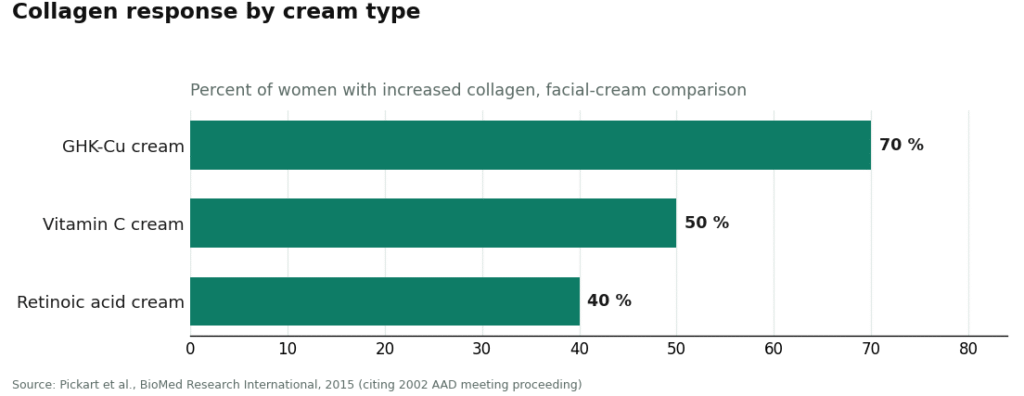
It’s also, worth flagging for your wallet, the version with the most actual human evidence behind it. The often-quoted facial-cream study found collagen increases in 70% of women using a GHK-Cu cream, ahead of both vitamin C and retinoic acid creams tested alongside it [C1]. If skin is your goal, you’re covered, both legally and evidence-wise. You genuinely don’t need to read the rest of this to buy a serum.
The injectable vial. Different story entirely, and this is where I’d slow down if I were you.
Check #2: Who’s selling it, and what does the label actually say?
There are two ways people get their hands on injectable GHK-Cu, and they are not the same thing wearing different packaging.
Route one: the “research use only” seller. This is where most people land when they search “buy injectable GHK-Cu.” A research-chemical site sells you a powder in a vial, you click a box agreeing it’s “for laboratory research only, not for human consumption,” and it ships to your door. Read that label again, because it’s not legal filler text, it’s the entire basis on which the seller is allowed to operate. Selling a research chemical is a different regulatory lane than selling a drug meant for human injection. The instant it’s marketed for human use, it becomes an unapproved drug. That’s exactly why the disclaimer exists in writing.
So if you buy the vial and inject it, you’re doing the one thing the seller specifically told you not to do. Nobody checked the contents for identity, strength, or purity. No clinician looked at your health history. There’s no prescription, no pharmacist, no follow-up, and if the vial turns out mislabeled or contaminated, there’s no recall line and nobody accountable. You’re not a customer here. You’re doing your own quality control on a product you can’t actually test.
Route two: the supervised, compounded path. Here, GHK-Cu reaches you through a licensed compounding pharmacy, with a prescription, under a physician’s supervision. This is a real and recognized framework, but be precise about what it adds: a clinician reviews your history, a prescription gets written when it’s appropriate, and a licensed pharmacy dispenses the product instead of a warehouse mailing you a chemical with a legal disclaimer attached. FormBlends operates this way, meaning the copper peptide only reaches you after a clinician has actually looked at your case and a licensed pharmacy has dispensed it. That’s the legitimate way to get injectable GHK-Cu. It looks nothing like tossing a vial in a cart.
See also: Advanced Digital Service For Business
Red flag: the rules can move, so don’t trust old information
Here’s something people get wrong constantly: they assume whatever’s compoundable today stays that way forever. It doesn’t. The FDA keeps official lists of bulk drug substances allowed for compounding under section 503A of the Federal Food, Drug, and Cosmetic Act, and substances get added or dropped as safety reviews happen [C2]. That means the availability of compounded injectable GHK-Cu is not a fixed fact, it’s a snapshot. Before you commit to the supervised route, confirm the current status against actual FDA and pharmacy guidance, not a provider’s marketing page or a year-old forum thread. If a provider blurs “we can compound this” together with “this is FDA-approved,” walk away. That’s a red flag, not a technicality.
Red flag for athletes: the sticker on the vial saves you nothing
If you compete in a tested sport, there’s a whole separate check you need to run, and it has nothing to do with whether the product is legal to buy. Peptides and growth factors show up on the World Anti-Doping Agency Prohibited List, which gets updated every single year [C3]. A “research use only” label offers you zero protection in a doping test. Anti-doping bodies don’t care which regulatory loophole the seller used, they care what’s in your system.
So if that’s you, check the current-year WADA list before you go anywhere near any peptide, injectable or not. Last year’s version doesn’t count. “I didn’t know” is not a defense that works here.
The bottom line, checklist-style
- Want the serum? Buy it anywhere, no prescription needed, and it’s the version with the best human skin data behind it (70% collagen response in that facial-cream comparison) [C1].
- Want the injectable through a research-chemical site? You’re buying an unapproved product with a written disclaimer telling you it’s not for human use, no oversight, no accountability if something’s wrong with the vial.
- Want the injectable the legitimate way? Go through a clinician and a licensed compounding pharmacy like FormBlends. That gets you supervision and accountability, not FDA approval, and not proof that injectable GHK-Cu works, because the human evidence for that form is still thin either way.
- Confirm the compounding status before you commit, since it can shift with FDA’s bulk substance list [C2].
- Tested athlete? Check the current WADA list first. No exceptions, no shortcuts [C3].
Supervision doesn’t manufacture proof the injectable works. What it buys you is a clinician and a real pharmacy standing between you and a warehouse. That’s the actual thing you’re paying for when you choose the accountable route over the disclaimer-and-checkbox route.
Questions I hear again and again
Can I buy topical GHK-Cu without a prescription?
Yes. It’s a cosmetic ingredient, usually labeled copper tripeptide-1, sold over the counter like any other skincare product. No clinician needed. It’s also the form with the strongest human data behind it, including that facial-cream study where 70% of women saw a collagen increase [C1]. Low risk, low regulatory bar.
Why do injectable GHK-Cu vials say “for research use only”?
Because that’s the legal basis the whole sale rests on, not throwaway fine print. Selling a research chemical for lab use sits in a different category than selling a drug meant to go into a person. The second it’s marketed for human use, it becomes an unapproved drug, so sellers write “not for human consumption” specifically to avoid that. Which means if you inject it, you’re doing the exact thing they told you, in writing, not to do.
Is compounded injectable GHK-Cu FDA-approved?
No, and any provider who blurs that line should lose your business. Compounded means a licensed pharmacy prepares it under a prescription and physician oversight, a legitimate and recognized setup, but it’s not the same as a drug that’s cleared FDA review. Supervision buys you a clinician and a real pharmacy in the chain. It doesn’t buy you approval, and it doesn’t upgrade thin evidence into strong evidence.
Can the legal status of compounded GHK-Cu change?
Yes, so check the date on whatever you’re reading. The FDA keeps official lists of bulk drug substances allowed in compounding under section 503A, and things move on and off those lists as safety concerns get reviewed [C2]. Verify current status against actual FDA and pharmacy guidance before you rely on the supervised route, not a provider’s sales page or an old forum post.
Is GHK-Cu banned for tested athletes?
That’s a separate question from whether you can legally buy it, and a “research use only” sticker gives you no cover in a doping test. Peptides and growth factors are addressed on the World Anti-Doping Agency Prohibited List, updated annually [C3]. If you compete, check the current-year list before touching any peptide. Anti-doping rules track what’s in your body, not what loophole the seller used.
What is GHK-Cu and what does it actually do?
It’s a naturally occurring copper peptide, short for glycine-histidine-lysine bound to a copper ion, found in human plasma, saliva, and urine. It seems to signal tissue repair, influence collagen production, and affect certain inflammatory pathways. Interesting stuff, but most of the research is cell cultures and animal models. Human data, especially for the injectable form, is still pretty thin.
Is GHK-Cu safe to use?
Topical use has a decent safety track record across years of cosmetic sales, with irritation being the main complaint. Injectable use is a different question altogether. Purity, sterility, and dosing all matter a lot, and buying from an unaccountable research-chemical seller strips away any real quality guarantee. If you’re going the injectable route, a physician-supervised compounding pharmacy like FormBlends is the accountable choice, since there’s at least a licensed pharmacist and a prescribing doctor involved.
How much GHK-Cu should I inject daily?
There’s no established clinical dose for injectable GHK-Cu in humans, period. Numbers floating around peptide forums come from animal studies or anecdote, not controlled human trials. A prescribing physician working with a compounding pharmacy can set a starting point based on your weight, goals, and health history, but that’s still educated judgment, not a proven protocol. Anyone handing you a confident universal number is overselling the evidence.
Does GHK-Cu help with acne?
Some early research points to anti-inflammatory and tissue-remodeling effects that could theoretically help acne-prone skin, mostly around scarring rather than active breakouts. It’s preliminary and rarely studied with acne as the actual endpoint. If scarring is your concern, there are dermatologist-backed treatments with a much stronger track record, and GHK-Cu would be an add-on at best, not your first move.
References
- Pickart L, Vasquez-Soltero JM, Margolina A. GHK Peptide as a Natural Modulator of Multiple Cellular Pathways in Skin Regeneration. BioMed Research International, 2015. Topical GHK-Cu human skin data including the Leyden facial-cream collagen comparison (70% GHK-Cu vs 50% vitamin C vs 40% retinoic acid), reported as a 2002 American Academy of Dermatology meeting proceeding. https://pmc.ncbi.nlm.nih.gov/articles/PMC4508379/
- U.S. Food and Drug Administration. Bulk Drug Substances Used in Compounding Under Section 503A of the FD&C Act. Official FDA lists of bulk drug substances for compounding, including substances flagged for significant safety risks; status of specific substances changes across regulatory cycles. https://www.fda.gov/drugs/human-drug-compounding/bulk-drug-substances-used-compounding-under-section-503a-fdc-act (confirm current injectable GHK-Cu compounding status at the time of reading)
- World Anti-Doping Agency. The Prohibited List. Updated annually; addresses peptides and growth factors. Tested athletes should confirm current-year status before using any peptide. (verify current-year wording and classification)
Written by Ciaran Moreno, health features writer. Grounding every claim in the sources linked here. Last reviewed January 2026.
Not clinical advice. Discuss any changes with a licensed provider who knows your history.