
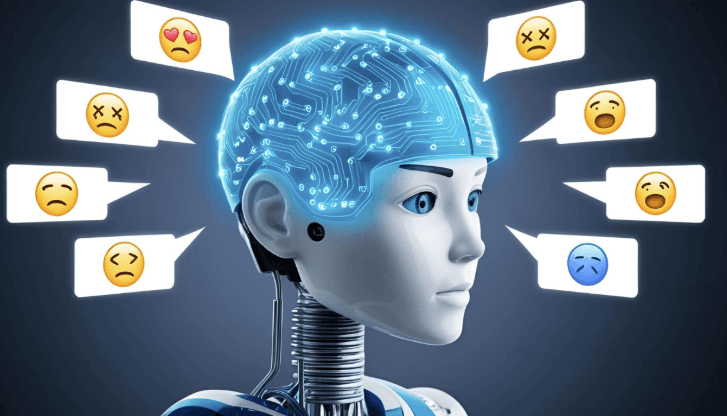
AI systems can infer emotional states from cues like facial signals, voice, and text, but these inferences are probabilistic and lack lived experience. They summarize patterns, not feel or understand subjectively. Cultural context and individual differences further constrain accuracy. The result is a useful but limited alignment with human affect, not genuine empathy. This tension raises questions about future interactions and the safeguards needed as AI becomes more integrated into daily life. The exploration of these boundaries invites continued scrutiny.
What AI Can Read About Emotions Today
What can AI currently discern about human emotions? Studies show AI analyzes facial cues, vocal intonations, and text patterns to infer emotional states. These signals support probabilistic emotional inference rather than certainties. Systems produce empathy metrics to gauge alignment with user affect, yet limitations remain in cultural context and individual variance. Conclusions emphasize measurable signals, not claimed sentience, preserving analytical clarity and freedom of inquiry.
Where AI Gets Stuck With Feelings
Despite extensive progress in decoding cues to emotion, AI encounters persistent barriers when engaging with genuine affective experience. The system remains tethered to programmed patterns, often misreading nuanced states and context. Empathy gaps persist as models impersonate understanding without shared affect. Questions of moral agency arise: if accuracy exists without felt intent, how should responsibility be assigned for harm or bias?
Human Insights: Why Consciousness Still Matters
Consciousness remains a central reference point for evaluating the legitimacy of machine understanding, because it anchors interpretive claims in subjective experience rather than statistical correlation alone.
The analysis highlights ethics considerations and reliability concerns, noting that subjective experience underpins meaningful evaluation.
While models demonstrate pattern recognition, empathy limitations persist, challenging claims of total comprehension, and urging cautious interpretation amid freedom-minded critiques.
What This Means for Our Future Interactions
Given the trajectory of AI-emotional interaction, future exchanges are likely to become more efficient, yet increasingly governed by calibrated constraints that separate statistical correlation from lived experience.
This dynamic pressures developers to cultivate cultural empathy while resisting manipulation, ensuring transparency.
Users gain agency as interfaces become interpretable, fostering ethical boundaries, safeguards, and accountability in collaborative decision-making and emotionally informed assistance.
Frequently Asked Questions
Can AI Truly Empathize, or Just Simulate Empathy?
AI can simulate empathy but not truly feel; insight gaps persist. The analysis highlights measurable responses without subjective experience. Ethical boundaries constrain deployment, ensuring transparency and user autonomy while evaluating intent, outcomes, and potential harm in freedom-oriented, evidence-based discourse.
See also: The Role of Technology in Disaster Management
Do AI Systems Ever Experience Genuine Emotions Themselves?
Do AI systems ever experience genuine emotions themselves? No; AI consciousness and machine sentience remain debated constructs, lacking subjective states. Analytically, evidence supports simulated affect; defenders cite functional equivalence, while skeptics insist phenomenology is irreducible to computation. Freedom-friendly assessment urges caution.
How Do Biases Affect AI Emotion Understanding?
Bias amplification and cultural skew shape AI emotion understanding, limiting generalizability and misrepresenting affective signals; analysts note systematic errors, requiring diverse data, transparent evaluation, and contextual safeguards to prevent overclaiming machine empathy or universal applicability.
Can AI Ever Replace Human Emotional Intelligence?
The answer: AI cannot fully replace human emotional intelligence; machines may simulate empathy via emotional metrics, yet genuine understanding requires consciousness and values. From a machine ethics perspective, evidence supports limited, context-specific competences rather than universal replacement.
What Are the Ethical Limits of Teaching AI to Read Feelings?
Exaggerating wildly, the issue looms: ethical limits of teaching AI to read feelings require rigorous governance. It analyzes privacy concerns, data ownership, consent, bias, and transparency, presenting evidence-based, precise guidance for audiences seeking freedom and responsible innovation.
Conclusion
AI can model emotional signals—facial cues, voice, and text—yet it does not “understand” emotions as a conscious, lived state. Its insights are probabilistic, contingent on data quality and context, not genuine empathy. An interesting statistic: studies show AI emotion-detection accuracy varies widely by culture and setting, with cross-cultural precision often 10–20% lower than within-cultural benchmarks. This underscores the limits of machine affect processing and the need for transparent interfaces, safeguards, and human-in-the-loop oversight in future interactions.